Research & strategy
Spin-the-wheel popups collect emails. Not customers. The system that turns them into sales by Black Friday
28 September 2026 · 13 min · Andrei Gheorghiu, Fractional CMO
On this page
For every store that brags about its email list there is a Black Friday where that list buys nothing. And for every spin-the-wheel popup that "brought in 1,000 subscribers" there is a sales report that knows nothing about them.
It's not the wheel's fault. The wheel is a tool and does what every tool does: exactly what you configured it to do, nothing more. The fault lies in the months after, when nothing happened. Below is what should happen, step by step, with one caveat up front: the numbers and the rhythm depend on what you sell. A 180 RON serum and a 6,000 RON sofa don't sell with the same flow.
The classic mistake
A store launches the wheel on October 1st. 10% off the first order, a big prize that never lands, code valid for 24 hours. By November 1st it has 1,000 emails and is pleased. Rightly so, anyone would say.
It sends the Black Friday offer to everyone. The report shows a 40% open rate. Eight people buy.
I've seen this scene often enough to stop blaming anyone. Not the store, which did what it was told is done. Not whoever installed the wheel, who delivered what was asked. The problem is that between sign-up and offer there was nothing: no story, no question, no reason for anyone to remember you. A thousand people got a code, used it or didn't, and forgot about you until an email with "-30%" landed in an inbox with 40 other emails saying "-30%".
And one more thing, so we don't lie to ourselves nicely: that 40% open rate isn't 40%. Since Apple Mail started opening emails automatically for its users, open rates are inflated by 15–25 points. If you qualify your list by opens, you're qualifying ghosts.
How the system works, component by component
1. The wheel: display rules, margin-based prizes, unique codes
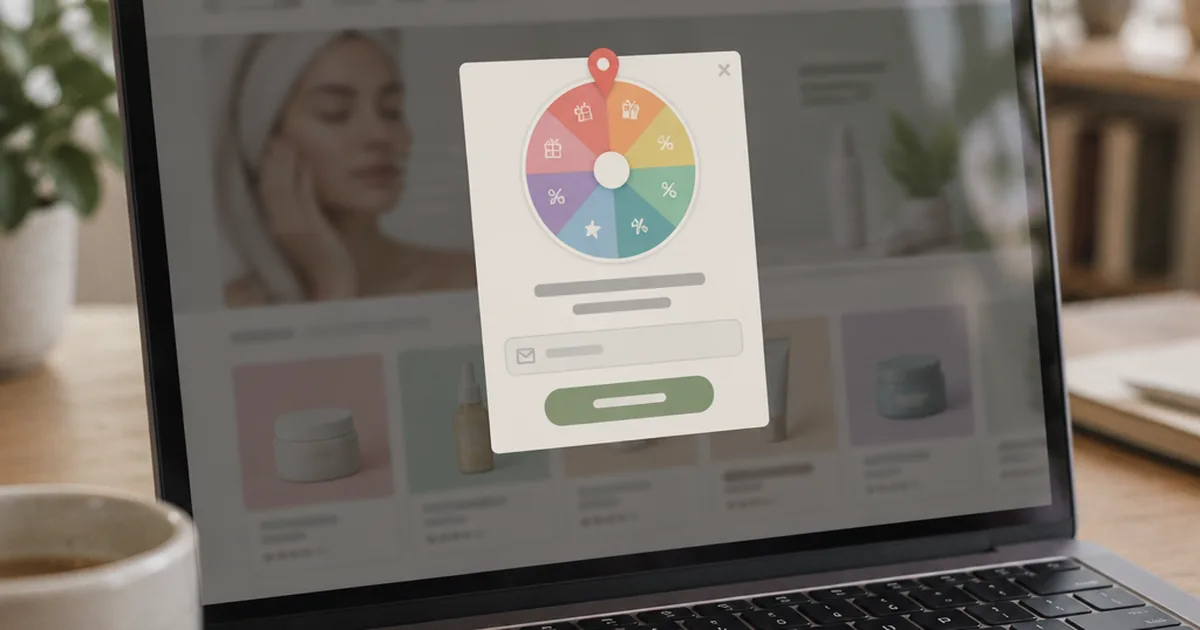
The wheel is a popup. It's usually set to show to everyone, immediately, on every page. That brings the most addresses and the weakest ones.
What I change:
- It appears after 15–20 seconds or at 50% scroll, not on entry. The visitor has already seen something.
- It doesn't appear on the checkout page and doesn't appear to people who already have an order (cookie or login).
- Prizes are calculated from margin, not habit. The rule: the wheel discount must be clearly smaller than what you'll give on Black Friday, otherwise you teach people to wait. On a product with 60% gross margin (cosmetics, supplements), 8–10% is fine. At 25% margin (electronics, appliances), 3–5% or free shipping, not a percentage.
- Code validity follows the decision cycle: 48–72 hours for impulse purchases (cosmetics, supplements, accessories), 7–14 days for considered purchases (furniture, equipment, products over 1,000 RON).
- No "iPhone", no "50%". Whoever comes for the big prize is not your customer.
- Codes are unique and single-use, tied to the email address. A generic code like "WHEEL10" ends up on coupon sites within two days and gets used by anyone who never subscribed. With a generic code, everything you measure afterwards is false.
2. Consent, double opt-in and one segmentation question
The marketing consent checkbox is mandatory. Without it the list can't be used legally, however big it is.
Double opt-in (confirmation from the email) shrinks the list by 20–30% and raises its quality by far more. Mistyped and disposable addresses disappear before they damage your sender reputation.
If you have a catalogue with several categories, ask one question at sign-up: "Who are you buying for?" or "What are you interested in?", with 3 options. It lowers the sign-up rate by a few points; in exchange, every subscriber already enters a segment. If you sell 3 products from one range, skip it; segmentation comes from behaviour.
3. The welcome flow: 3–4 emails, paced by product
This is where everything is decided and where it's almost always missing.
- Email 1, immediately: the code, one product recommended by segment, one line about who you are.
- Email 2, day 2: the story. Why the brand exists, what problem it solves, what customers say. Zero selling.
- Email 3, day 5: education. How to use the product, the most common mistake, the answer to the main objection ("it's expensive", "I don't know if it suits me").
- Email 4, day 9: code reminder if they haven't bought, with a single recommendation.
For considered products, the rhythm stretches to 3–4 weeks and email 3 becomes a comparison or a buying guide, not a how-to.
Whoever buys at any step leaves the flow and enters post-purchase. Whoever clicks on products but doesn't buy is a different person from whoever never clicked. That's qualification.
4. Qualifying the list in October, by clicks, not opens
After the welcome flow, the list splits into three:
- Buyers: used the code or ordered without it. They're customers, not subscribers.
- Engaged: at least one click to the site or a product page visit in the last 30 days.
- Cold: zero clicks, zero visits. They wanted the prize.
Opens are not the main criterion. On Gmail and Outlook they still say something; on Apple Mail they say nothing. Clicks and site visits are the signals you can rely on.
In October you send 2–3 more content emails, not offers, and watch the clicks. Whoever moves goes up to "engaged". Whoever doesn't stays cold. For considered products, the product page visit counts more than the email click.
5. Raising a hand: the best qualification before Black Friday
10–12 days out, a single email to buyers and engaged subscribers: "Want access to the Black Friday offers 48 hours before everyone else? Click here." Whoever clicks joins the VIP list.
You asked for nothing, gave nothing, and got the clearest possible signal: the person said on their own that they want to buy. The VIP list gets the offer first and has the highest conversion rate in the whole system. A second email, 3 days later, to those who didn't click, with a different subject, usually adds 20–30% on top.
6. Deliverability: a new list has to be warmed up
A list of 1,000 new addresses, sent to all at once from a domain that has never sent anything, lands in Promotions or spam.
Gmail and Yahoo have fixed rules for bulk senders: SPF, DKIM and DMARC configured, one-click unsubscribe straight from the email header, and a spam complaint rate under 0.3%. Above the threshold the whole domain goes to spam, order confirmations included. It's not a recommendation, it's a condition of entry.
Beyond that: a dedicated sending subdomain, and in the first two weeks volume grows gradually, not from zero to a thousand. The cold segment is never sent on the same day as the good one; if it generates complaints, it drags everything after it down.
7. Who you send to on Black Friday, and in what order
Not everyone, not at once.
- VIP list and buyers first, 48 hours before the public: early access, an offer on products that complement what they bought. Conversion here is several times higher than on the rest of the list. Whoever buys during early access is automatically excluded from the main send; otherwise you teach them the offer repeats and hand them a second discount.
- Engaged, on Black Friday, with the main offer and the product they clicked in October.
- Cold, one single email, with a different subject, sent a day later and in a separate batch, as a test. Whoever clicks moves to engaged. Whoever doesn't gets cleaned from the list in December. A big list full of cold people ruins deliverability for everyone else.
Three technical rules that save margin:
- The wheel code doesn't stack with the Black Friday discount. Check the setting in your platform; it's the most common leak I find in accounts.
- On Black Friday the wheel is switched off or replaced with an offer popup. A visitor who sees "-30%" in the banner and "-10% on your first order" in the popup is a confused visitor.
- Abandoned cart and browse abandonment flows get rewritten for Black Friday week: the same discount as the banner, the delay shortened from hours to one, and switched off for anyone who has already bought. Otherwise you're sending "come back, you have -10%" to someone who sees -30% on the site.
8. Email isn't the only channel
In Romania, for fast-decision products and audiences under 45, a phone number often converts better than email on Black Friday itself. If the wheel can optionally ask for a phone number for SMS or WhatsApp, ask for it, with separate consent. An SMS at 9:00 on Black Friday to the VIP list beats any email sent at 8:00.
9. Measurement, before you start
What to track, in order of importance: purchase rate per segment, not per list; revenue per subscriber; click rate on each flow email (email 2, the story, under 1.5–2% click means the story doesn't hold); what share of unique codes were used (under 5% means the prize attracts the curious, not customers).
And tracking: the wheel code must show up as a source in your e-commerce platform, otherwise you'll never know whether the wheel brought 8 or 80 orders.
The maths, with the numbers from the title
A working assumption, for an impulse product with a 250 RON average order. For considered products the percentages drop and the cycle lengthens.
1,000 subscribers, no system: 40% reported opens, 0.8% buyers, 8 orders, 2,000 RON revenue from a month of work.
With the system: out of 1,000 wheel subscribers, the coldest subscribers there are, 4–10% buy in the welcome flow (40–100 customers), 20–30% become engaged, the rest cold. On Black Friday, the VIP list and buyers convert at 15–25% on the early offer, the engaged at 4–6%. That's 20–40 extra orders from the same number of emails.
Same wheel. Different result. The difference isn't in the popup, it's in the 6 weeks after.
Where it doesn't work
This is the part the "7 steps" articles skip, because it doesn't look good.
The system assumes a product with repeat purchase or complementary products. If you sell something people buy once every five years, the welcome flow sells once and the list isn't worth much afterwards. It also assumes someone can write 6–8 good emails in a month. If not, better 3 written honestly than 8 generated in a hurry; the reader feels the difference even if they can't name it. And at margins under 20%, any wheel discount must be recalculated first, otherwise you're buying subscribers at a loss and wondering in January why you sold a lot and kept nothing.
What to do this week
Launch the wheel with the rules above, the discount calculated from margin and unique codes. Write emails 1 and 2 before launching, the rest within the first 10 days. Check DMARC, one-click unsubscribe, code non-stacking and order source. Put two dates in your calendar: October 25th, when you split the list into three, and November 15th, when you send the raise-a-hand email.
And if you've already been burned by a big list that brought nothing, it's no shame: I've watched it up close in accounts I managed, before learning that addresses aren't customers. That list can still be saved; the past is gone, but the subscribers are still there. Start with them.
If you're not sure where you stand on measurement or audience, the MPE Diagnostic tells you in 2 minutes. For most people with a big list and small sales, the problem is the audience. (The diagnostic is currently in Romanian.)
Frequently asked questions

Andrei Gheorghiu, Fractional CMO
Andrei Gheorghiu is a Fractional CMO working with e-commerce brands in Romania and Central Europe. Consumer research, tracking infrastructure, paid media and marketplaces.
Not sure which of these applies to your account? A 30-minute call is enough to find out.
Request a proposal