Research & strategy
Should you post on social media? Yes, but not the way you think
22 September 2026 · 5 min · Andrei Gheorghiu, Fractional CMO
On this page
The most common question I get from friends who run a business isn't about ads. It's this: "Should I be posting on Facebook and Instagram? How often?"
The short answer: yes, you should. But the question is the wrong one, and the wrong question produces months of posts that bring in nothing.
Posting is not a strategy. It's an action.
Imagine you have a rifle and a box of bullets. Someone asks: "Should I shoot?" It depends. At what? Why? What happens if you hit?
That's what most business accounts look like on social media: they shoot. Product photo on Monday, motivational quote on Wednesday, "have a great weekend" on Friday. Every post is a bullet fired in whatever direction felt right that day. There's noise, there's no result, and after three months the conclusion is "social media doesn't work for my business".
Social media isn't the problem. Shooting without a target doesn't work.
First question: what do you want to happen?
Before any post, one clear answer: what should the person who sees it do?
Not "find out about us". That's not a goal, it's a hope. Real goals for a small business:
- Walk into the shop or visit the site and buy.
- Book a table, a consultation, an appointment.
- Leave an email or a phone number.
- Come back, if they've bought once already.
- Recommend you to someone else.
Each of these needs a different post, a different tone, a different rhythm. A restaurant that wants bookings tonight posts differently from a furniture workshop that wants an order in three months. If you don't know your goal, every post is equally good and equally useless.
Second question: who is the target?
This is where most businesses get stuck, and it's exactly the part marketing is supposed to do before anyone presses "post".
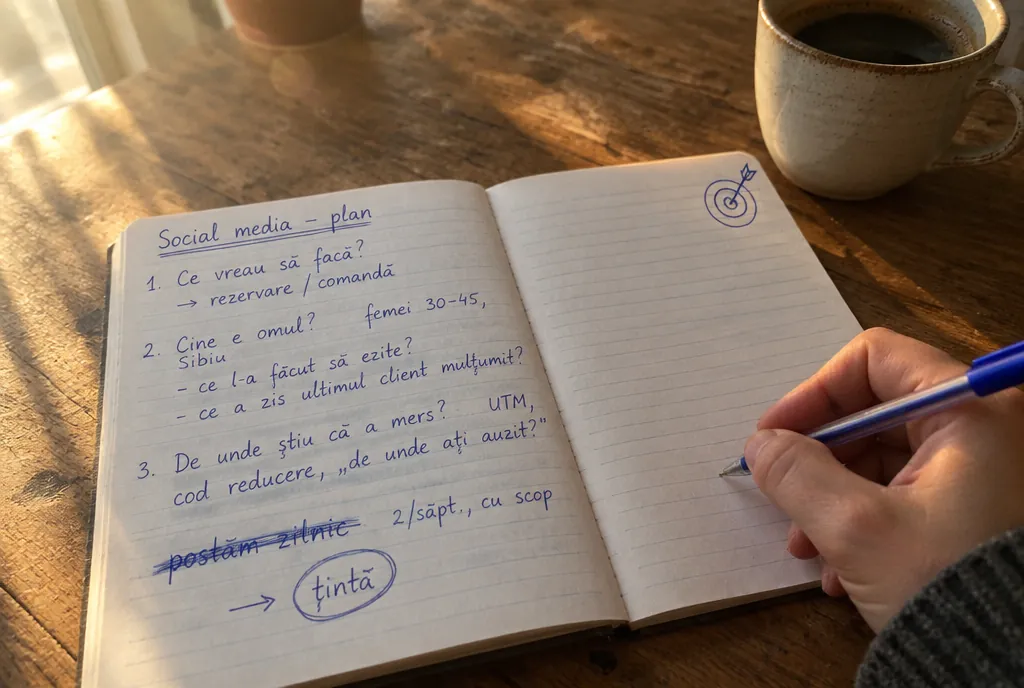
"Everyone" is not a target. "Women 25–45 in Sibiu" is slightly better, but it still doesn't tell you what to write. A real target answers questions like: what problem does this person have when they come to you? What made them hesitate last time? What did your last happy customer say when they recommended you? What did they last click on?
The answers don't come from intuition. They come from conversations with customers who have already bought. Three to five 20-minute conversations tell you more than six months of random posting. And that's where the topics, the words and the moments that actually move something come from.
Third question: how do you know it worked?
If the goal is "bookings", you count the bookings that came from posts, not the likes. If it's "online sales", you look at social media visits that turned into orders, not at reach. Likes are applause. Applause doesn't pay the rent.
That means a minimum of measurement: links with parameters, a dedicated discount code, a question on the phone: "how did you hear about us?". Nothing complicated, but without it you never find out whether you're shooting in the right direction.
Only then: what and how often
Once you have the goal, the target and the measurement, "what do I post" answers itself. You post the things that move your target one step closer to the action you want: proof that you know what you're doing, an answer to their hesitation, a reason to come today rather than next month.
And "how often" becomes a question of capacity, not of algorithm. Two good posts a week, made with a purpose, beat seven posts made so the page doesn't go quiet. The algorithm doesn't reward frequency. It rewards people's reactions, and people react to what fits them.
What I tell my friends
Yes, post. But first write three answers on a piece of paper: what do I want the person seeing this to do, who is that person, and how will I know it worked. If those three answers are blank, you don't have a social media problem. You have a strategy problem, and no number of posts will fix it.
I don't manage social media pages and I don't post for anyone. I do exactly the part that comes before: the research, the target, the plan. If you want to see where you stand, the MPE Diagnostic tells you in 2 minutes whether your problem is measurement, audience or execution. For most people posting without results, it's the audience. (The diagnostic is currently in Romanian.)
Frequently asked questions

Andrei Gheorghiu, Fractional CMO
Andrei Gheorghiu is a Fractional CMO working with e-commerce brands in Romania and Central Europe. Consumer research, tracking infrastructure, paid media and marketplaces.
Not sure which of these applies to your account? A 30-minute call is enough to find out.
Request a proposal